
AI Is Not Skynet: Separating Business Risk From Science Fiction
AI & Governance
8–10 minutes
AI Is Not Skynet: Separating Business Risk From Science Fiction
AI does create real business risk. Most of it is not a robot uprising. The risks businesses need to manage today are far more ordinary: bad data, weak oversight, privacy exposure, automation bias, fraud, vendor dependency, and people trusting systems they do not understand.
KEY TAKEAWAYS

- AI risk is real, but the most immediate business risks are operational, legal, financial, security-related, and human.
- Science-fiction framing can be distracting because it encourages businesses to focus on dramatic future scenarios while ignoring problems already happening inside everyday workflows.
- The practical response is not panic or blind adoption. It is governance.
- Businesses need to know what AI is doing, what information it is using, where human review belongs, and who remains accountable for the outcome.
The AI conversation has a branding problem
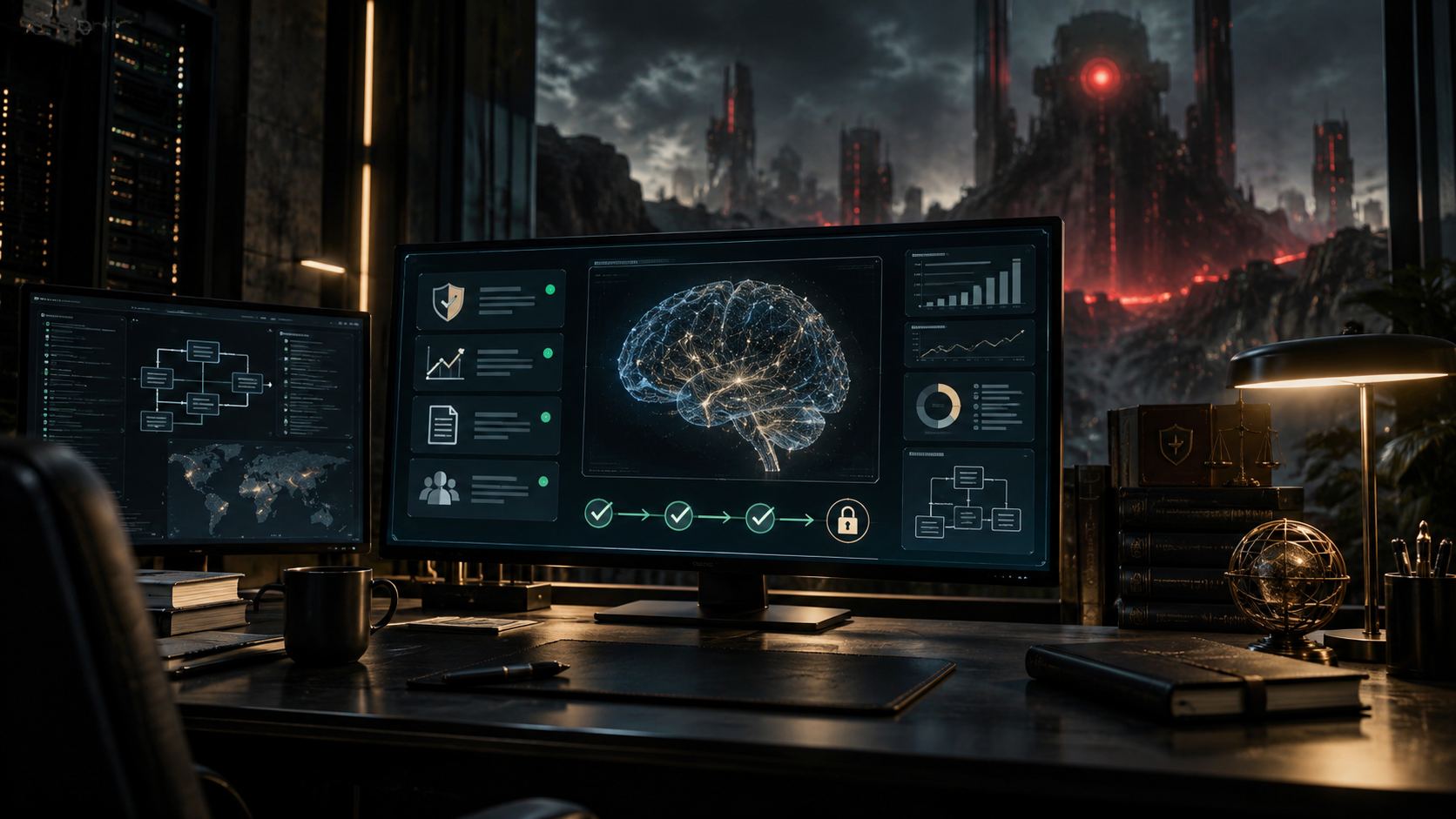
For decades, artificial intelligence has been framed through fiction.
- Machines become self-aware.
- Systems decide humans are inefficient.
- Computers take control.
- Someone inevitably says Skynet.
It makes for good storytelling. It is not a particularly useful way to evaluate whether your employee should paste a customer contract into an AI tool. That is where the business conversation needs to become more grounded.
There are legitimate debates about what increasingly capable AI systems could mean over the long term. Those debates deserve serious attention. But the owner of a construction company, design firm, manufacturing operation, restaurant group, or professional services business has a different problem today.
They need to know whether the AI tool their company is already using can expose data, generate bad information, create compliance issues, weaken accountability, or quietly become part of a workflow nobody has properly reviewed.
Those risks are less cinematic. They are also much more likely to affect the business this week.
1. The first real risk is believing the output because it sounds intelligent
Generative AI is extremely good at producing confident language. That creates a psychological problem. People naturally associate fluency with competence. If an answer is polished, structured, and delivered instantly, it can feel authoritative even when it is incomplete or wrong. That is one of the most important risks businesses need to understand. An employee may use AI to:
- summarize a contract
- interpret a policy
- draft a client recommendation
- explain a regulation
- troubleshoot code
- research a technical requirement
- generate financial commentary
- prepare a proposal
The problem is not that AI assisted. The problem begins when nobody verifies what matters.
AI can be useful without being authoritative. Those are different things.
2. The second risk is bad information moving faster
Before AI, weak information usually moved at human speed:
- Someone researched poorly.
- Someone misunderstood something.
- Someone copied an outdated document.
AI changes the velocity. One weak assumption can now become: a proposal, email sequence, SOP, client report, policy, presentation, website page, training document, and automation workflow in a fraction of the time.
Efficiency amplifies whatever enters the system. If the source material is sound, that can be valuable. If the assumptions are wrong, AI can help distribute the mistake beautifully.
That is why better automation does not reduce the need for judgment. It increases the importance of good inputs and review.
3. Privacy risk is much more realistic than robot rebellion
A business does not need sentient AI to create a serious problem. It only needs someone to share information they should not have shared. Employees may paste:
- customer information
- contracts
- internal financials
- employee records
- proprietary procedures
- sensitive emails
- source code
- strategic plans
- legal correspondence
- credentials or configuration details
into tools without understanding what happens to that information afterward. The right question is not: “Is AI dangerous?” It is: “What data are we putting into which systems, under what controls?”
That is a much more actionable risk question.
4. Automation bias is one of the quietest risks
Automation bias happens when people give too much weight to a system recommendation because the system appears objective or sophisticated. You can already see this in ordinary software:
- If the dashboard says the lead is low quality, someone may stop looking.
- If the fraud system says the transaction is suspicious, someone may assume it is.
- If the AI summary says the contract contains no major issue, someone may skim less carefully.
AI can make this tendency stronger because the output sounds conversational and reasoned. That is why human review cannot simply mean: A person looked at it.
Meaningful human review means the person understands what they are reviewing and has the authority to disagree.
5. AI can create security problems without “hacking” anything
AI risk and cybersecurity risk increasingly overlap. Again, the realistic problems are not usually dramatic. They include:
- employees exposing sensitive data
- attackers using AI to create better phishing messages
- impersonation through synthetic voice or video
- fabricated screenshots or documents
- AI-generated malicious code
- fake customer or executive requests
- automated social engineering
- weakly governed AI integrations with internal systems
The technology can make old attack methods faster and more convincing. That matters because humans are still part of the security boundary.
A fake message does not need to be perfect. It only needs to be believable long enough for someone to act.
6. Deepfakes are a business continuity problem now
Synthetic media used to be easier to spot. That is changing. Voice cloning, generated images, manipulated video, and AI-written communication make impersonation easier. Businesses should assume that visual or audio evidence alone will become less trustworthy. That has practical implications.
- A finance employee may need a second verification channel before processing an unusual payment request.
- A business owner may need a verbal code or known callback process for high-risk instructions.
- Teams may need to verify unexpected requests even when the voice sounds familiar.
That is not science fiction. That is process design.
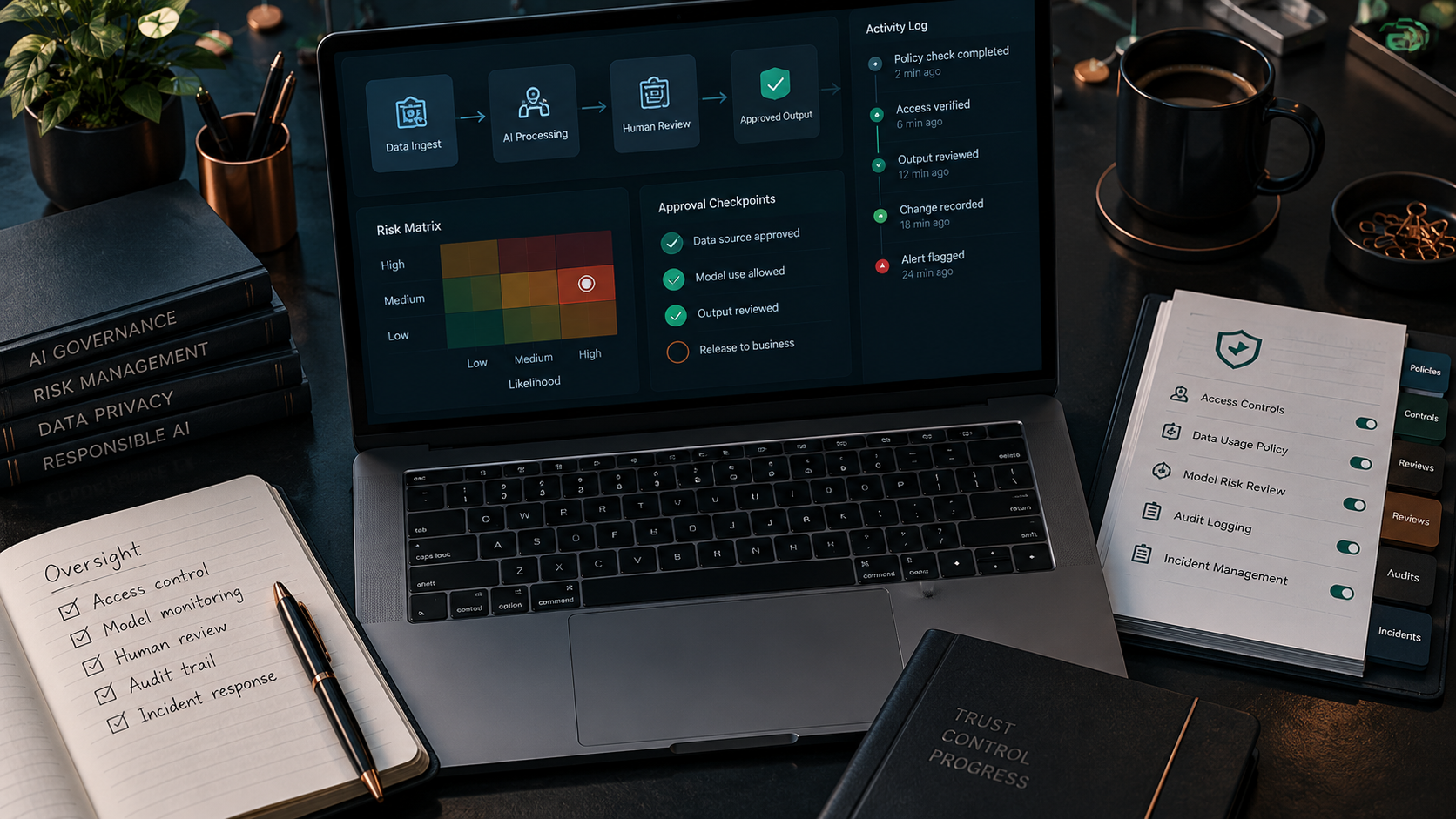
AI risk becomes manageable when it is translated into business controls.
EmberNova Digital helps businesses evaluate where AI is already entering workflows, what data is being exposed, where human review belongs, and what governance should exist before adoption expands.
7. Vendor dependency is an underrated AI risk
AI features are being embedded into almost every category of software.
- CRM.
- Accounting.
- Email.
- Search.
- Project management.
- Customer service.
- Design.
- Analytics.
- Cybersecurity.
- Operations.
That creates convenience. It also creates dependency. Businesses should ask:
- What happens if the vendor changes pricing?
- What happens if a feature disappears?
- Can the business export its data?
- Can the AI function be disabled?
- Does the business understand what information is being sent to third-party systems?
- Is a critical workflow dependent on a model or provider the business cannot control?
The risk is not necessarily that AI fails catastrophically. Sometimes the risk is that a business builds an important process on a feature it never truly owned.
8. AI can make weak processes look modern
This one is especially dangerous.
- A business has a messy process.
- Too many spreadsheets.
- Unclear approvals.
- Duplicate entry.
- No consistent ownership.
- Nobody knows which version is current.
Then AI is added. Now the messy process produces output faster.
That is not transformation. It is acceleration. AI should not be used to disguise operational debt. Before adding AI to a workflow, ask whether the workflow itself is sound.
A weak process with AI is still a weak process. It is just harder to recognize because the interface looks more advanced.
9. Not every AI decision needs the same level of control
One reason AI governance sounds intimidating is that people imagine everything needs a committee. It does not. Risk should match consequence.
Using AI to brainstorm social post ideas is low consequence.
Using AI to draft a client-facing engineering recommendation is not.
Using AI to rewrite a paragraph is low consequence.
Using AI to determine whether an employee should be disciplined is not.
Using AI to summarize notes is low consequence.
Using AI to make a financial or legal decision is not.
The organization should not treat all AI use equally. It should classify use by risk.
That is a much more practical approach.
10. Human-in-the-loop only works if the human can actually intervene
“Human in the loop” sounds reassuring. Sometimes it is meaningless.
- If the human reviewing the output does not understand the task, they are not really supervising anything.
- If the system produces hundreds of recommendations and the reviewer is expected to approve them rapidly, oversight becomes ceremonial.
- If employees believe they will be punished for disagreeing with the AI recommendation, review loses its value.
Human oversight only matters when the human has:
- enough context
- enough expertise
- enough time
- enough authority
- enough accountability
Otherwise, the person becomes a rubber stamp.
11. The risk of hallucination gets too much attention and not enough context
By now, many people know that generative AI can hallucinate. That is useful awareness. But the phrase can become oversimplified.
The real business question is: What happens if this system is wrong?
If AI invents a synonym in a brainstorming exercise, almost nothing happens. If it invents a legal citation, regulation, technical requirement, or financial assumption and nobody checks it, the consequences can be serious.
The risk is not simply that hallucinations exist. The risk is deploying AI into situations where an incorrect answer carries meaningful consequences without designing adequate review.
Context matters.
12. Bias is not just a social issue. It is an operational issue.
AI systems learn from historical information. Historical information contains patterns. Some patterns are useful. Some reflect incomplete data, outdated practices, stereotypes, or uneven representation.
If businesses use AI in hiring, customer segmentation, risk evaluation, performance management, lending, pricing, or similar decisions, bias can become operational. Even lower-stakes uses can introduce assumptions into language and recommendations.
The appropriate response is not to assume every AI output is biased. It is to recognize that “the computer said it” does not make the result neutral.
13. The biggest business risk may be accountability drift
This may be the most important issue of all. The more AI is involved in work, the easier it becomes for responsibility to become unclear.
- The employee says the system recommended it.
- The manager says the employee approved it.
- The vendor says the model produced it.
- The organization says nobody intended the outcome.
That is accountability drift. Businesses need to prevent it deliberately:
- Someone should still own the decision.
- Someone should understand the process.
- Someone should be able to explain why the output was accepted.
Technology can assist. Responsibility cannot disappear into the workflow.
14. What about the bigger existential AI debate?
There are serious researchers, technologists, policymakers, and institutions debating long-term AI safety. Questions around highly capable autonomous systems, loss of control, alignment, concentration of power, and systemic risk should not be dismissed simply because they sound futuristic.
But those debates operate at a different level than most day-to-day business decisions. A company can acknowledge long-term concerns while still focusing on the risks it can manage today. Those include: privacy, security, fraud, misinformation, automation bias, poor governance, weak processes, vendor dependency, accountability, and inappropriate delegation.
You do not have to choose between: “AI will save everything.” and “AI will destroy everything.”
There is a much more useful position in the middle: AI is powerful technology. Powerful technology requires competent use.
15. Good governance is boring by design
Responsible AI does not need to feel futuristic. It often looks like:
- approved tools
- clear data rules
- risk classifications
- human review
- access controls
- logging
- documentation
- vendor evaluation
- incident response
- training
- defined accountability
That is not as exciting as a robot uprising. It is much more useful.
Good governance turns abstract risk into manageable operational controls.

What this means for your business
If your AI strategy starts with fear, you may avoid useful tools. If it starts with hype, you may adopt them carelessly. Neither is particularly strong. Start with what the business is actually doing.
- Where is AI already being used?
- What information is entering those systems?
- Which outputs affect customers, employees, money, legal obligations, safety, or reputation?
- Where should human review remain mandatory?
- Who owns the outcome?
- Which vendors are becoming part of critical workflows?
Those questions will tell you more about your real risk than another argument about science fiction. The business does not need a bunker.
It needs visibility.
"The most dangerous AI risk in your business probably does not look like Skynet. It looks like a confident answer, a weak process, and nobody asking who checked it."
- RACHEL CROW, FOUNDER, EMBERNOVA DIGITAL
A Practical AI Risk Check
Before expanding AI use, ask:
What are we using?
Identify the actual tools and embedded AI features already in the business.
What data goes into them?
Know whether customer, employee, proprietary, regulated, or confidential information is involved.
What happens if the output is wrong?
Different consequences require different controls.
Where does a human review the result?
Make sure the review is meaningful.
Who owns the decision?
Do not let accountability become ambiguous.
What happens if the vendor changes or disappears?
Understand dependency before a feature becomes infrastructure.
That is AI governance in practical terms.
Practical AI Integration & Governance
EmberNova Digital helps businesses identify practical AI opportunities while building the controls needed to use them responsibly.
That can include AI workflow evaluation, governance, internal-use guidelines, human review points, data boundaries, risk classification, automation design, and integration with existing business systems.