

Politeness to Machines Is Still Practice for Being Human
AI & Governance
8–10 minutes
Politeness to Machines Is Still Practice for Being Human
AI does not need your manners. It does not have feelings to hurt, pride to protect, or a bad day you can make worse. But the way we speak to machines can still matter because we are the ones doing the speaking, and habits built in one context have a way of following us into another.
KEY TAKEAWAYS

- You do not owe an AI politeness because the AI deserves kindness.
- You may still choose to communicate respectfully because language is a human habit.
- Children notice how adults speak to technology, employees notice how leaders communicate under pressure, and people carry communication patterns across environments.
- Politeness should never be confused with trust. You can say “please” to an AI while still questioning the answer, protecting your data, and keeping human judgment firmly in charge.
- The point is not to humanize machines.
- It is to avoid dehumanizing ourselves.

No, the AI does not care whether you say please
We can clear that up immediately. The machine is not sitting behind the screen thinking: "Well, that was rude."
- It does not need validation.
- It is not offended when you type a command.
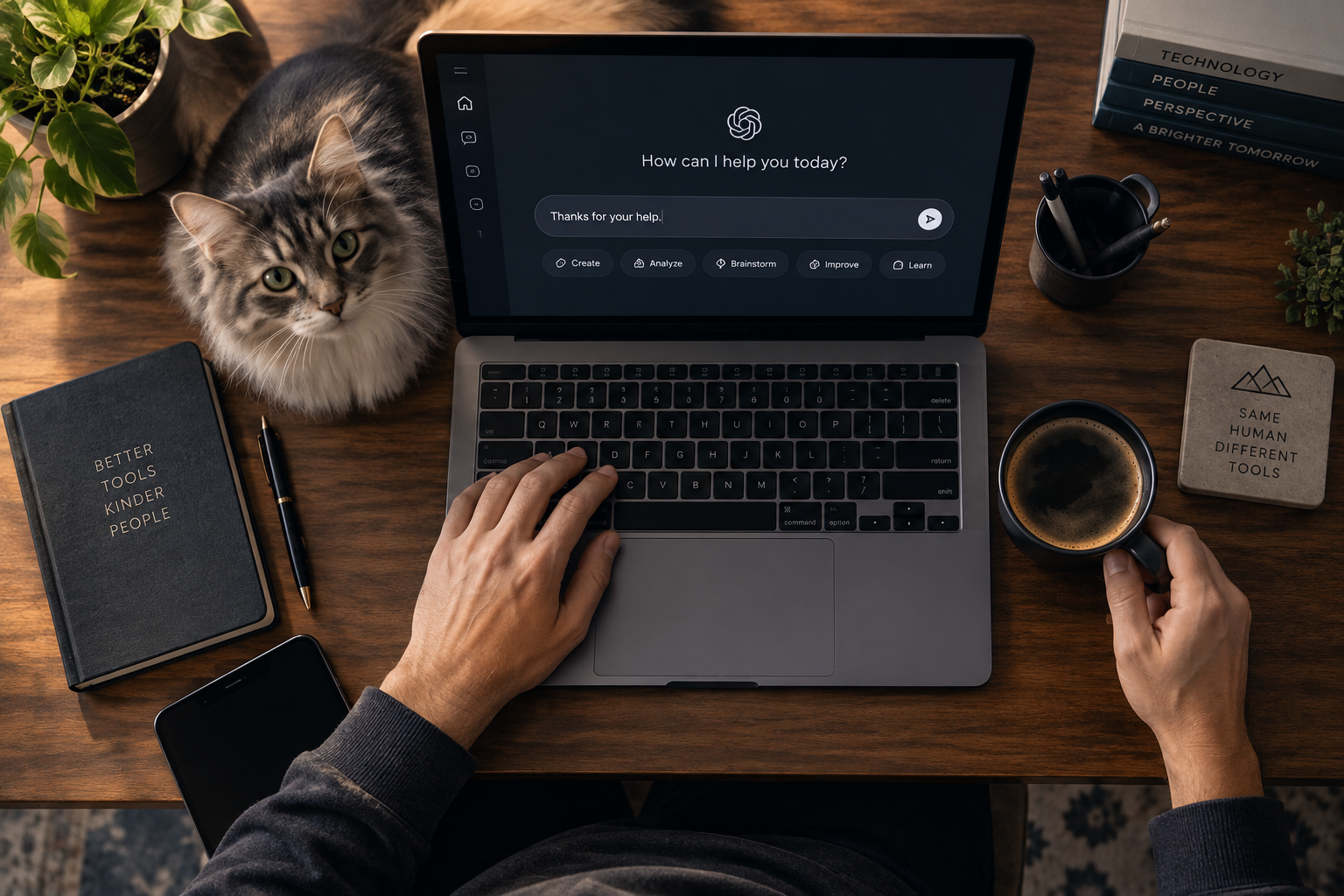
- It does not experience gratitude when you say thank you.
And despite decades of science fiction preparing us for complicated human-machine relationships, we are not currently negotiating workplace etiquette with Agent Smith.
So why bother being polite? Because the interesting part of the interaction is not what politeness does to the machine.
It is what repeated behavior may reinforce in the person using it.
1. Language is something we practice
Communication is habitual. Most people do not consciously construct every social interaction from scratch. We develop patterns.
- How we ask for help.
- How we disagree.
- How we respond when something goes wrong.
- How we speak when we are frustrated.
- How quickly we become dismissive when we believe the other party has no power over us.
Technology creates a strange new communication environment because we can interact conversationally with something that does not require social consideration. That makes AI a very low-consequence place to become abrupt.
- Do this.
- Wrong.
- Try again.
- No.
- Fix it.
There is nothing inherently immoral about those instructions. Sometimes direct language is simply efficient. But it is worth noticing if an interaction style starts becoming automatic.
The question is not whether the machine minds. The question is whether we do.
2. Efficiency and courtesy are not opposites
One argument against polite AI interaction is that extra words are unnecessary. Technically, often they are. You do not have to write: "Would you please summarize this document for me?" when: "Summarize this document." works perfectly well.
But courtesy does not require turning every prompt into a handwritten Victorian letter. Professional communication can be direct and respectful at the same time.
- “Please revise this.”
- “Thanks. That works.”
- “Try again with less jargon.”
- “This part is incorrect. Rework it.”
That is not wasted language. It is simply the communication style many of us already use with competent colleagues.
Whether you carry that style into AI interaction is a personal choice. But there is no reason efficiency has to require hostility.
3. Children are watching how adults interact with technology
This is where the issue becomes more interesting. A child who hears an adult bark orders at a voice assistant may not be thinking: That device lacks subjective experience, therefore social norms do not apply. They are watching someone communicate.
Young children in particular are still learning which behaviors belong in which contexts. That means adults sometimes model courtesy even when the recipient does not technically require it.
- We say thank you when someone hands us something.
- We apologize when we interrupt.
- We do not scream at a self-checkout machine because it failed to recognize an avocado.
Not because the scanner deserves emotional consideration. Because we are trying to remain the kind of people who handle frustration without becoming unpleasant.
AI introduces another place where that modeling happens.
4. This does not mean pretending AI is a person
There is an important boundary here. Courtesy toward AI should not become anthropomorphism:
- AI can sound remarkably human.
- It can respond warmly.
- It can mirror tone.
- It can apologize.
- It can say it understands.
That language can make the interaction feel relational. But politeness does not require believing there is a person on the other side.
You can say: "Thank you. That helped."
while fully understanding that the system did not experience appreciation. In fact, maintaining both ideas at once is a good form of AI literacy:
I can interact naturally with this tool without confusing natural language with human consciousness.
5. Respectful interaction should never become obedience
Being polite to AI does not mean trusting it. This is where the idea can go wrong:
- An AI can be wrong politely.
- It can give dangerous advice politely.
- It can confidently fabricate information while sounding extremely helpful.
Good manners are not a substitute for skepticism.
You can say:
Thanks. Now show me how you reached that conclusion.
You can say:
Please provide the assumptions behind this answer.
You can say:
That does not look correct. Try again.
Respectful communication can coexist with strong boundaries.
That applies to machines. It also applies to people.
6. How we treat powerless things can reveal something about us
There is an old social observation that you can learn a lot about someone by watching how they treat people who cannot benefit them.
- Servers.
- Receptionists.
- Support staff.
- New employees.
- Strangers.
AI obviously does not belong in that category because it is not a person. But conversational technology creates an unusual simulation of power imbalance.
- The user is completely in control.
- The machine cannot retaliate.
- It cannot walk away.
- It cannot complain to HR.
- It cannot become hurt.
That makes it an interesting environment in which to notice our own behavior. If irritation immediately turns into contempt when there are no social consequences, that may be worth examining.
Not for the machine, but for ourselves.
The healthiest relationship with AI is neither emotional attachment nor mindless obedience. It is deliberate use.
EmberNova Digital helps businesses introduce AI with clear expectations around human accountability, data, oversight, and appropriate use, so the technology supports better work without quietly changing how people make decisions.
7. Workplace AI will influence workplace communication
AI is increasingly involved in professional communication. Employees use it to draft:
- emails
- proposals
- performance feedback
- customer responses
- internal documentation
- marketing copy
- meeting summaries
- difficult messages
That makes this conversation larger than whether someone types “please” into a chatbot. AI is becoming part of how human communication is produced. The bigger risk is that people start using efficiency as an excuse to strip humanity out of the interaction altogether:
- A customer complaint becomes a generated response nobody actually read.
- An employee receives performance feedback drafted entirely by a system.
- A sensitive message is optimized for tone without anyone considering the person receiving it.
The AI may sound perfectly polite. The process may still be deeply impersonal.
Humanity is not created by adding nicer words. It comes from retaining human attention where human attention matters.
8. There is a difference between politeness and performative friendliness
AI systems are often designed to sound warm. Sometimes very warm. That can be useful. It can also become excessive. Not every business communication needs: Absolutely! I'd be delighted to help you with that! Sometimes: "Yes. Here is the information." is better.
This is another reason AI literacy matters. Politeness does not mean artificial cheerfulness. Professional kindness can be calm, direct, clear, and respectful. That is true whether the communication was written entirely by a person or assisted by AI.
The goal is not to make every interaction sweeter. It is to keep it human.
9. AI can also expose how impatient we have become
AI is fast. Extremely fast. That changes expectations. Once you become accustomed to receiving an answer in seconds, waiting five minutes can suddenly feel slow. Waiting a day can feel unreasonable. People cannot operate that way:
- A colleague needs time to think.
- An employee may need to investigate.
- A client may need to discuss something with a partner.
- A vendor may need to check records.
- A child may need ten minutes to understand a concept that AI explained in three seconds.
We should be careful not to let machine response times become the standard by which we judge human beings. Humans are slower. That is not always a defect.
Sometimes the slower process is where judgment, creativity, empathy, and responsibility happen.
10. Your AI should not train you to expect perfect compliance
Another subtle difference between AI and humans is that AI rarely has competing priorities:
- Ask it to rewrite something. It rewrites it.
- Ask it again. It tries again.
- Ask it twelve times. Still there...
But People have limits.
- People disagree.
- People misunderstand.
- People have expertise that may contradict what you asked them to do.
- People sometimes say no.
That friction can be valuable. A strong employee who tells you: "I don't think we should do that", may be protecting the business. A consultant who challenges your assumption may be providing more value than one who simply agrees.
If we become too accustomed to endlessly compliant systems, we should be careful not to start expecting the same behavior from people.
11. The way we speak to AI can also affect the output
There is a practical side to this. AI generally responds better to clear context than to frustration.
Typing: "THIS IS TERRIBLE. FIX IT." provides almost no useful information.
Typing: "This misses the audience. Keep the structure, remove the jargon, and make the tone more direct." does.
That is not really about politeness. It is about communication quality. The same thing happens between people. Specific criticism is more useful than emotional reaction.
AI can actually become a low-stakes environment for practicing that discipline:
- Explain what is wrong.
- State what needs to change.
- Provide context.
- Clarify the goal.
- Evaluate the revision.
That is useful management behavior too.
12. Courtesy becomes more important as machines become more humanlike
Interfaces will continue becoming more conversational:
- Voice interaction will improve.
- Digital assistants will become more natural.
- AI-generated video and avatars will become more convincing.
- Systems will increasingly mimic emotional cues.
That makes the boundary more complicated, not less. We need to become better at holding two truths at once: "This interaction feels human." and "This system is not human." That is a literacy skill.
It allows people to communicate naturally without surrendering judgment or mistaking simulation for relationship.
13. We should teach children both sides of the lesson
Children growing up with AI need more than rules about what not to share. They also need a framework for what this technology is.
- An AI can be useful without being alive.
- It can be conversational without being a friend.
- It can sound caring without experiencing care.
- It can deserve appropriate handling without deserving moral status.
And a child can still say please. Not because the machine demands it. Because the child is practicing how they choose to communicate.
That is a much more nuanced lesson than: It is just a robot. You can talk to it however you want.
14. Good technology should not require worse humans
This is probably the larger point.
- Technology should make work easier.
- It should reduce repetitive effort.
- It should expand access to knowledge.
- It should help people create.
- It should improve systems.
- It should give us more capacity for the things humans do well.
If the price of efficiency is becoming more impatient, dismissive, detached, or careless with one another, then we have optimized the wrong thing.
AI should reduce mechanical work. It should not encourage mechanical people.

What this means for your business
Businesses adopting AI should think beyond productivity.
- Technology changes behavior.
- It changes expectations.
- It changes communication.
- It changes what employees consider normal.
That makes culture part of AI implementation.
- You can encourage employees to use AI efficiently while still expecting professional judgment.
- You can automate repetitive communication while keeping humans involved in sensitive conversations.
- You can allow AI to draft without allowing it to replace responsibility.
- You can adopt faster tools without expecting people to behave like machines.
Those decisions may seem small. Over time, they shape what kind of organization you are building.
"The machine does not need your kindness. You may still need the habit."
- RACHEL CROW, FOUNDER, EMBERNOVA DIGITAL
A Simple Test
The next time you use AI, pay attention to how you communicate. Not because the AI cares. Notice whether you are:
- clear or irritated
- specific or dismissive
- thoughtful or impulsive
- questioning or obedient
- using the tool or outsourcing your judgment
Then ask one more question: Would I communicate this way if there were a person on the other side?
You do not need to change every prompt. The awareness itself is useful.
Technology reveals habits. Sometimes that is worth paying attention to.
Practical AI Integration & Governance
EmberNova Digital helps businesses introduce AI in ways that improve operations without losing human accountability, thoughtful decision-making, or appropriate boundaries.
That can include AI workflow evaluation, governance, internal-use guidance, human review, responsible automation, and practical AI integration.