
SYSTEMS & CAPACITY REVIEW
Find what is actually limiting your business.
Your capacity problem may be coming from people, processes, systems, decision bottlenecks, or work that should no longer require manual effort. EmberNova Digital reviews how the work actually moves through the business and identifies where capacity is being lost.
Structured review. Clear bottlenecks. Practical next steps.
2026 Best of Florida® Winner · Business Consulting Firms
Florida-based · Serving businesses nationwide · Licensed & Insured · Confidential by design
Systems & Capacity Review is part of EmberNova Digital’s Strategic Operations practice.
Before you add another person, find out where the work is getting stuck.
Growing businesses often respond to overload by adding staff, software, or another layer of management. Sometimes that is the right answer. Sometimes the real problem is unclear responsibility, repeated approvals, manual work, disconnected systems, poor handoffs, or too much knowledge sitting with one person.
A Systems & Capacity Review looks at how work moves through your business, where decisions slow down, what depends too heavily on the owner or key employees, and whether your existing systems are supporting the workload effectively.
CAPACITY PROBLEMS ARE NOT ALWAYS HEADCOUNT PROBLEMS.
WHAT WE REVIEW
We follow the work, not just the org chart.
The review looks across the parts of the business that determine whether work can move efficiently without unnecessary escalation, duplication, or dependence on specific people.
The goal is to identify where capacity is being consumed and what is actually causing the constraint.
The exact environment varies by business, but the review may include:
Roles & Responsibilities
Who owns recurring work, where responsibilities overlap, and where nobody has clear authority.
Owner & Key-Person Dependency
Which decisions, approvals, relationships, knowledge, and routine tasks still depend on the owner or another critical person.
Workflows & Handoffs
How work moves between people, departments, vendors, and systems, including where it stalls, gets repeated, or disappears into informal processes.
Systems & Software
Which tools support the work, where systems are disconnected, where information is entered repeatedly, and where workarounds have become part of normal operations.
Manual & Repetitive Work
Recurring administrative tasks, copying, follow-up, reporting, approvals, and other work that may be simplified, delegated, integrated, or automated.
Documentation & Decision Rights
Whether people know how work should be done, what they are authorized to decide, and what happens when the usual person is unavailable.
WHAT YOU RECEIVE
Clear findings you can use to make better operating decisions.
The review turns day-to-day friction into a documented picture of where the business is dependent, inefficient, unclear, or unnecessarily manual.
Capacity & Dependency Map
A documented view of the major people, processes, systems, and dependencies affecting day-to-day operations.
Bottleneck Findings
Identification of approvals, handoffs, recurring delays, duplicate work, and other constraints reducing capacity.
Owner & Key-Person Dependency Findings
Visibility into work, decisions, knowledge, and relationships that depend too heavily on one person.
Systems & Workflow Findings
Identification of disconnected tools, repeated data entry, software workarounds, and processes that are fighting the technology.
Automation & Delegation Opportunities
Clear identification of work that may be better delegated, documented, simplified, integrated, or automated.
Prioritized Action Plan
A practical sequence of what should be addressed first, what can wait, and which issues require deeper investigation or implementation.
You leave with a clearer picture of what is consuming capacity and a prioritized plan for improving it.
Implementation is separate from the review.
If systems work, automation, process redesign, documentation, training, or other implementation is needed, EmberNova Digital can scope that work separately.
Before you hire around the problem, find out what the problem actually is.
A Systems & Capacity Review can help distinguish a genuine staffing need from a workflow, delegation, systems, or operating-model problem.
Clear findings. Prioritized next steps. Implementation scoped separately when needed.
HOW THE REVIEW WORKS
A structured review from operating friction to action.
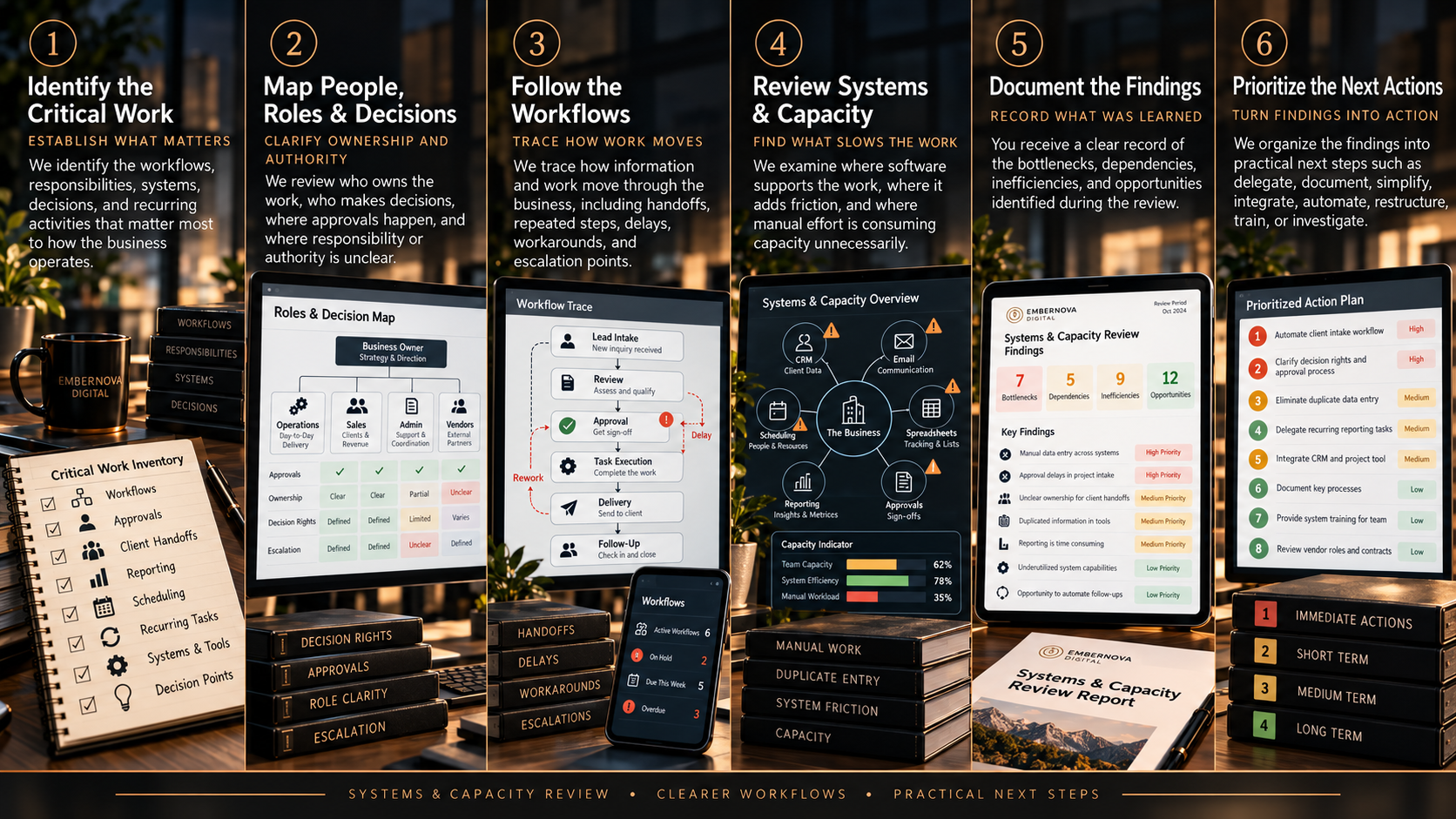
1. Identify the critical work
We establish which workflows, responsibilities, systems, decisions, and recurring activities matter most to how the business operates.
2. Map people, roles & decisions
We review who owns the work, who makes decisions, where approvals occur, and where responsibility or authority is unclear.
3. Follow the workflows
We trace how information and work move through the business, including handoffs, repeated steps, delays, workarounds, and escalation points.
4. Review systems & capacity
We examine where software supports the work, where it adds friction, and where manual effort is consuming capacity unnecessarily.
5. Document the findings
You receive a clear record of the bottlenecks, dependencies, inefficiencies, and opportunities identified during the review.
6. Prioritize the next actions
We organize findings into practical next steps such as delegate, document, simplify, integrate, automate, restructure, train, or investigate.
The result is a documented view of what is limiting capacity, why it is happening, and what should be addressed first.

The review gives you evidence for deciding where additional people, better systems, clearer processes, or automation will actually help.
WHY THIS REVIEW MATTERS
More capacity does not always require more payroll.
Operational friction accumulates gradually. An approval gets added. Someone creates a spreadsheet. A manager starts compensating for a broken workflow.
The owner becomes the default decision-maker. Eventually the business feels overloaded even though the underlying problem may be structural.
What this can improve
Less owner dependence - Identify routine decisions, approvals, knowledge, and work that should no longer require the owner.
Better use of existing staff - See where capable people are losing time to unclear processes, manual administration, duplicate work, or unnecessary escalation.
Cleaner workflows - Find where work slows down, loops backward, gets handed off poorly, or depends on informal workarounds.
Better use of software - Understand where existing tools are helping, where they are being underused, and where disconnected systems are creating more work.
Smarter hiring decisions - Separate legitimate capacity needs from work that could first be simplified, delegated, integrated, or automated.
Stronger operating resilience - Reduce dependence on undocumented knowledge and individual people so the business can function more consistently as it grows or changes.
INVESTMENT & TIMELINE
A defined review with a clear scope.
$1,250 fixed fee
Most Systems & Capacity Reviews are completed within 5–7 business days once intake is complete and the required information is available.
Your review includes:
- structured operational intake
- roles and decision-rights review
- workflow and handoff analysis
- owner and key-person dependency review
- systems and manual-work assessment
- capacity and bottleneck findings
- prioritized action plan
- final findings report and review call
Implementation is not included in the review. If additional operational, systems, automation, software, or documentation work is needed, EmberNova Digital will scope that separately based on the findings.
Designed for established small and midsize businesses with a typical operating environment. Multi-entity organizations or unusually complex operations may require a custom scope.
You leave with a documented ownership picture, clear findings, and a practical remediation path.
WHY EMBERNOVA DIGITAL
A review built around business control, not just technical access.
EmberNova Digital looks at digital ownership from an operational perspective: who controls the accounts, how access is transferred, where vendor dependencies exist, and whether the business can continue operating when people or providers change.
- Principal-led review and findings
- Experience across websites, domains, hosting, Microsoft 365, Google Workspace, business systems, and vendor-managed platforms
- Ownership and continuity considered alongside technical access
- Recommendations based on what the business actually needs, with remediation scoped separately




Featured in Best of Florida
The Business That Runs Itself
A closer look at why stronger systems, clearer ownership, and less dependence on one person matter as businesses grow, change, or prepare for what comes next.
COMMON QUESTIONS
A strong business foundation starts with knowing what the business actually needs.
What information do you need for the review?
That depends on your business. Intake may include information about roles, recurring workflows, software, approvals, responsibilities, documentation, reporting, and areas where work regularly slows down or escalates.
Do you need access to all of our software?
Usually not. The review starts with the operating environment and the problems being investigated. We may need visibility into specific systems or workflows where they are relevant, but access is requested only when it contributes to the review.
Is this an employee performance review?
No. The purpose is to understand how the operating system around the people is functioning. The review looks at responsibilities, workflows, decision rights, systems, documentation, and dependencies rather than rating individual employees.
How long does the review take?
Most Systems & Capacity Reviews are completed within 5–7 business days once intake is complete and the required information is available. More complex environments may take longer.
Will you tell us if we actually need to hire?
The review can identify whether the evidence points toward a genuine capacity constraint, operational friction, owner dependency, inefficient workflows, systems limitations, or some combination of them. Hiring may be one possible response, but the review does not begin with that assumption.
Is implementation included in the $1,250 fee?
No. The review identifies and prioritizes the issues first. Any process redesign, automation, software implementation, documentation, training, or other follow-on work is scoped separately.
READY TO FIND OUT WHAT IS ACTUALLY LIMITING CAPACITY?
Start with a Systems & Capacity Review.
Get a documented view of the bottlenecks, dependencies, workflows, systems, and operating constraints affecting your business, along with a prioritized plan for what to address next.
$1,250 fixed fee
Clear findings. Better operating decisions. Implementation only where the evidence supports it.