
Your Business Should Be Able to Run Without You
Operations & Fractional COO
Read time: 8–10 minutes
Your Business Should Be Able to Run Without You
A healthy business should not stop moving because the owner takes a day off, gets sick, travels, or simply steps away from the inbox. Reducing owner dependency starts with clearer roles, documented decisions, reliable systems, and operating routines that do not live entirely in one person’s head.
KEY TAKEAWAYS

- Owner dependency is an operational risk, not proof of commitment.
- If routine decisions, approvals, client communication, and problem-solving all require the owner, the business has a systems problem.
- Documentation matters, but SOPs alone will not fix unclear roles or weak accountability.
- The goal is not to remove the owner from the business. It is to stop making the owner the only thing holding it together.
- Stronger operations improve continuity, scalability, delegation, and transferability.
The business should not need you for everything
Many owner-led businesses become successful because the owner is deeply involved. They know the customers. They remember what was promised. They know which vendor to call, where the old file lives, and which client needs a different approach.
That involvement can be valuable, but it can also become a structural weakness.
A business becomes overly dependent on its owner when routine work, ordinary decisions, approvals, communication, and problem-solving consistently stop until that person becomes available. The clearest sign is simple:
If the owner steps away for several days and normal operations begin to stall, too much of the business is still living inside one person.
That is not a time-management problem. It is an operating-system problem.
1. Owner dependency usually develops gradually
Most businesses do not deliberately build themselves around one person. It happens in small increments.
- The owner approves one more thing because it is faster.
- A team member asks a question instead of documenting the answer.
- A customer exception gets handled informally.
- A vendor relationship stays attached to the founder’s personal email.
- A spreadsheet works well enough, so nobody redesigns the process.
Over time, the owner becomes the connection point between people, information, and decisions. The business may look organized from the outside while internally relying on constant intervention.
That works until volume increases, the team grows, or the owner simply cannot keep absorbing every dependency.
2. The symptoms usually show up before the business recognizes the problem
Owner dependency often appears as recurring operational friction. Common signs include employees waiting for routine approvals, client questions automatically escalating to the owner, deadlines living in one person’s memory, work slowing down whenever the owner is unavailable, and vacations that still require daily checking.
None of those issues alone means the business is broken. Together, they can indicate that the company has outgrown an informal operating model.

3. Being needed is not the same as being valuable
This distinction matters. Owners sometimes interpret constant involvement as evidence that they are essential to the business. They may be essential. But a business that cannot function without the owner is not necessarily stronger because of that.
It may simply be more fragile. The owner’s highest-value contribution should increasingly come from strategy, leadership, major relationships, financial decisions, growth priorities, and complex exceptions. That is very different from spending the day answering questions the system should already know how to handle.
A mature operation should make the owner more valuable by reducing unnecessary dependence on them.
4. Start by identifying what only you know
One of the fastest ways to find owner dependency is to make a list of information that currently exists mostly in your head.
That might include pricing logic, discount rules, vendor preferences, client history, escalation thresholds, approval rules, project sequencing, renewal dates, quality standards, and how you know when something is wrong.
Then ask: What would happen if nobody could ask me about this for one week?
That question exposes the difference between knowledge that is simply useful and knowledge the business cannot operate without. The second category deserves attention.
5. Clarify decisions before documenting procedures
Businesses often jump straight to SOPs. Documentation is important, but a procedure cannot solve a decision that has never been defined. Before writing instructions, clarify who owns the decision, what that person is allowed to decide, when approval is required, what the acceptable limits are, what happens outside those limits, and where the decision is recorded.
For example, “process customer refunds” is not enough. The team may also need to know who can approve a refund, up to what amount, under which circumstances, and when the owner must become involved.
That is operating structure. The SOP comes after the structure is clear.
If your business keeps routing ordinary decisions back to you, the problem may not be workload. It may be the operating structure underneath it.
6. Build clear ownership into the business
A task can be delegated without truly being owned. Someone may be responsible for doing the work but still depend on the owner for every judgment call. True ownership requires clarity around the expected outcome, authority, timing, standards, escalation, documentation, and measurement.
People perform better when they understand both the responsibility and the boundaries around it. That also makes accountability more useful. Instead of asking why something did not get done, the business can ask whether ownership was clear, whether the information was available, whether the person was authorized to act, and whether the process was defined.
That produces better operational improvement than simply adding another reminder.
7. Stop using the owner as the integration between systems
Sometimes the dependency is not really about people. It is about disconnected technology:
- A lead comes in through one platform.
- The owner forwards it to someone else.
- A quote is created in another tool.
- A project begins in a spreadsheet.
- A reminder lives in email.
- An update is sent through text.
- The owner becomes the human middleware connecting systems that do not communicate.
That creates unnecessary dependence. Better system design may include centralized CRM records, shared task visibility, automated handoffs, connected forms, recurring reports, permission-based access, and clearer operational dashboards.
Technology should reduce the need for the owner to carry information between systems. It should not simply give the owner more places to check.

8. Build escalation paths instead of automatic owner involvement
Not every exception can be documented in advance. That is normal. The goal is not to eliminate escalation. The goal is to make escalation deliberate. A useful structure might look like this:
- Level 1: The team member handles the issue using established rules.
- Level 2: A manager or designated lead handles a more complicated exception.
- Level 3: The owner becomes involved because the issue carries meaningful financial, legal, client, or strategic impact.
Without a structure like this, everything becomes Level 3. The owner gets pulled into routine matters because the business has not defined where ordinary judgment should live.
9. Create visibility without requiring constant involvement
One reason owners stay deeply involved is fear of losing visibility. That concern is legitimate. Delegation without visibility can create new problems.
The answer is not to remain inside every task. It is to build better operational visibility. That can include weekly KPI summaries, project status reporting, pipeline visibility, outstanding-task reports, financial dashboards, issue logs, and recurring leadership reviews.
A good operating system allows the owner to see what matters without manually inspecting everything.
The goal is controlled visibility, not constant participation.
10. Pressure-test the business by stepping away
You can learn a great deal about operational maturity by deliberately becoming less available for a short period. Before stepping away, note what questions you expect, what approvals normally come to you, what systems require your login, what customers typically ask for you directly, and what recurring work you personally trigger. Then observe what happens.
What stopped?
What waited?
What became confused?
What was handled correctly without you?
The goal is not to prove that nobody needs you. It is to identify where the business still depends on you unnecessarily.
11. Reducing owner dependency supports more than growth
This work is often discussed as a scaling strategy. It is bigger than that. Lower owner dependency improves continuity, delegation, growth, hiring, succession, and transferability.
A company that operates through documented systems, roles, and controls is easier for another leader to understand. A business does not have to be preparing for a sale for transferability to matter.
Transferability is simply evidence that the operation exists beyond one person.
12. The goal is not to make the owner irrelevant
That is not the objective. The owner may remain central to vision, relationships, strategy, culture, or major decisions. The goal is to make that involvement intentional. The owner should be involved because their judgment adds value:
- Not because nobody else knows the password.
- Not because every decision lacks a rule.
- Not because the client history only exists in their inbox.
- Not because the process stops without a reminder.
A stronger business still benefits from its owner. It just does not require the owner to personally hold every piece together.
What this means for your business
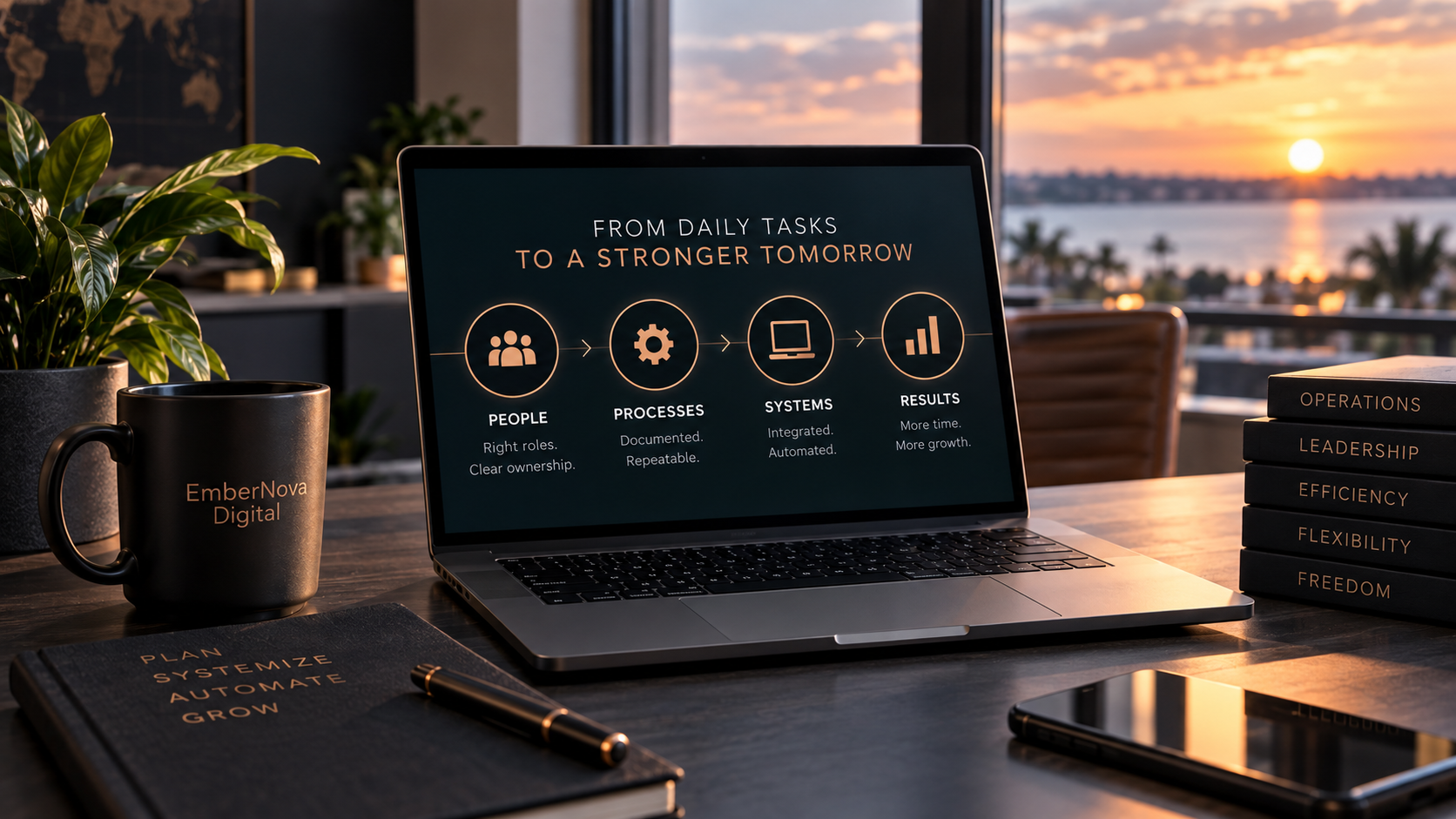
If your business cannot run without you, start by identifying where the dependency actually lives. It may be information, approvals, customer relationships, systems, passwords, reporting, process knowledge, unclear roles, or undocumented exceptions.
Do not try to fix all of it at once:
- Choose one recurring dependency.
- Clarify who should own it.
- Document the decision rules.
- Give the right person access.
- Connect the necessary systems.
- Create visibility.
Then move to the next one.
That is how a business gradually becomes easier to run without becoming harder to control.
"The goal is not to build a business that does not need its owner. It is to build one that does not need the owner for work the system should already know how to handle."
- RACHEL CROW, FOUNDER, EMBERNOVA DIGITAL
Fractional COO & Operational Strategy
EmberNova Digital helps owner-led businesses reduce operational friction, clarify responsibilities, improve decision flow, strengthen systems, and build operating structures that can support growth without placing every dependency back on the owner.
Work may include process design, role and responsibility mapping, workflow modernization, operational documentation, system selection, implementation priorities, and ongoing fractional COO support.
Explore Fractional COO & Operational Strategy →