
How to Use AI Without Removing Human Accountability
AI & Governance
Read time: 8–10 minutes
How to Use AI Without Removing Human Accountability
AI can speed up research, drafting, classification, analysis, and routine decision support. The problem starts when a business lets the system make consequential decisions without clear human ownership, verification, or escalation.
KEY TAKEAWAYS

- AI should support accountable people, not replace accountability.
- Human review matters most when the work affects money, customers, compliance, security, or reputation.
- “Human in the loop” only works when the human actually has authority, context, and time to review.
- AI outputs should be treated as inputs to a process, not automatic truth.
- Good governance defines who reviews, who approves, what gets logged, and when AI should stop.
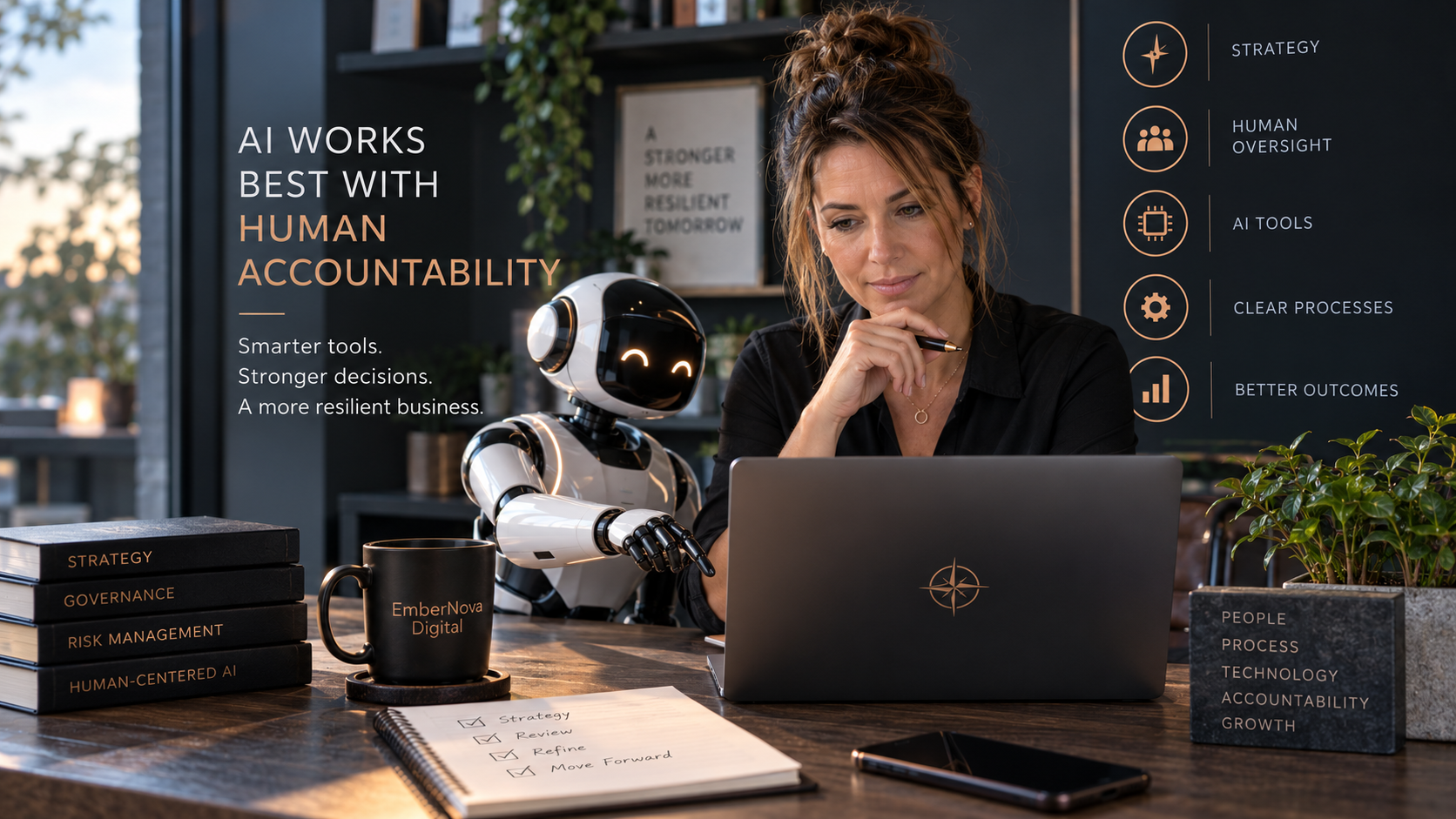
AI should make people more capable, not less responsible
Businesses are adopting AI quickly because it can remove friction from work that used to take much longer. It can summarize documents, draft communications, classify requests, organize information, generate options, surface patterns, and support decisions. That can create real operational value. It also creates a new question:
Who is responsible when the AI gets it wrong?
The answer cannot be “the AI.” AI does not carry accountability inside your organization. People do.
The practical goal is not to keep humans manually doing everything. It is to design workflows where AI handles the work it is good at while responsibility remains clearly assigned to a person.
1. Accountability has to exist before AI enters the process
AI governance often gets treated like a policy problem. It is usually an operating problem first. Before adding AI to a workflow, the business should already know:
- who owns the process
- what outcome is expected
- which decisions require approval
- what information can be used
- what level of error is acceptable
- what happens when something is uncertain
- who handles exceptions
If those answers are unclear before AI is introduced, the technology can make the uncertainty harder to see. AI can execute or assist within a process. It cannot repair unclear ownership by itself.
2. Not every AI task needs the same level of oversight
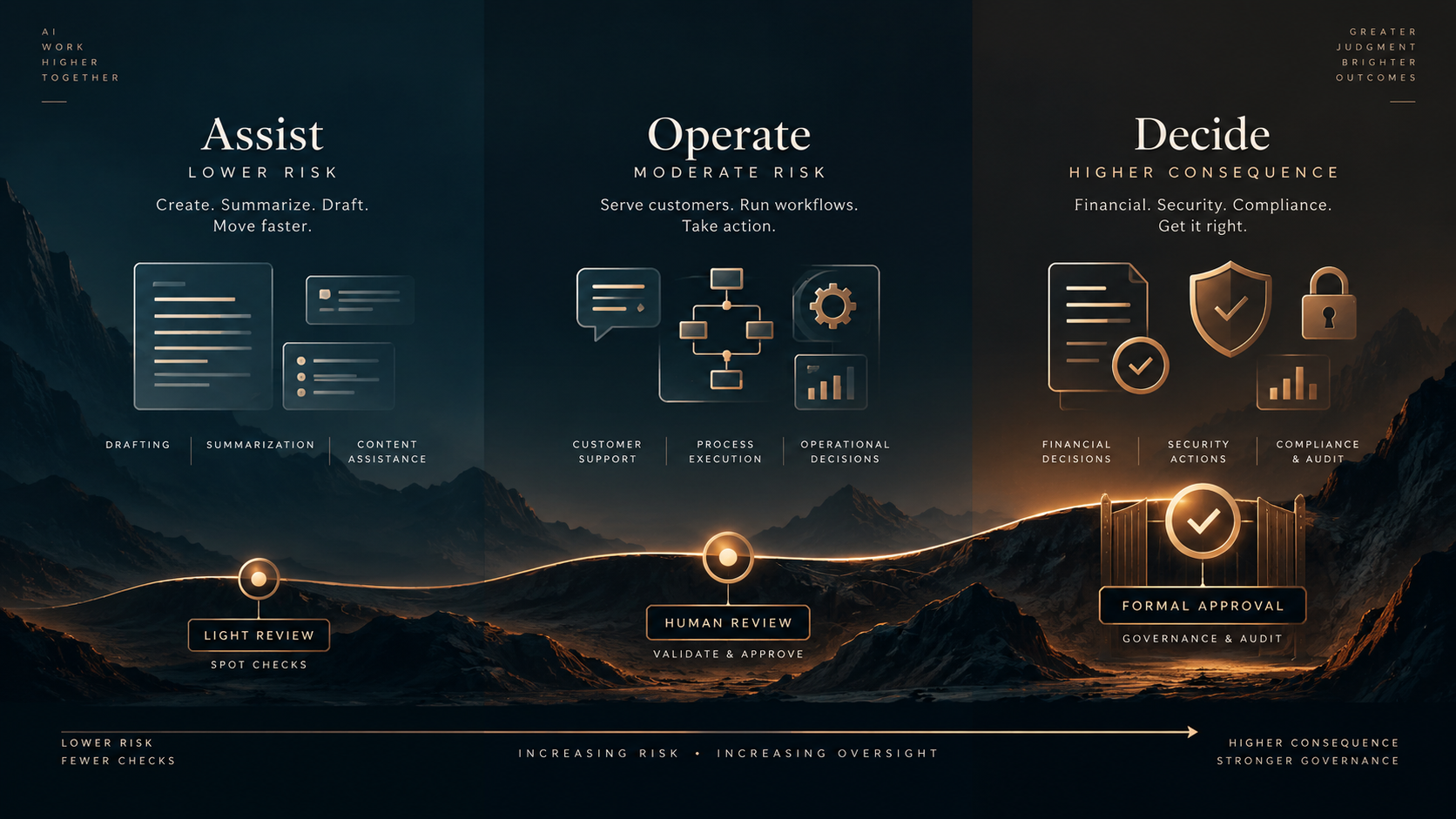
The amount of human review should match the consequence of the task. A low-risk internal brainstorm is not the same as a customer-facing decision. An AI-generated meeting summary is not the same as an AI-generated contract clause. A draft social caption is not the same as a security recommendation.
It helps to think about AI use in tiers.
Lower-risk work
Examples may include:
- brainstorming
- first drafts
- formatting
- internal summaries
- categorization
- idea generation
These uses still deserve review, but mistakes are usually easier to identify and correct.
Moderate-risk work
Examples may include:
- customer communications
- research summaries
- operational recommendations
- internal analysis
- workflow classification
- lead or request categorization
These tasks need stronger verification because incorrect output can affect other people or business decisions.
Higher-risk work
Examples may involve:
- financial decisions
- legal interpretation
- regulatory or compliance matters
- security decisions
- employment decisions
- sensitive customer data
- health or safety
- irreversible customer outcomes
In these situations, AI should not become the final authority simply because it can produce an answer quickly.
3. “Human in the loop” is not enough by itself
The phrase sounds reassuring. But a human review step can become meaningless if the reviewer:
- does not understand what they are reviewing
- assumes the AI is probably right
- has too much volume to review properly
- does not know what evidence the AI used
- lacks authority to stop the workflow
- only checks for obvious formatting problems
- becomes conditioned to approve everything
A checkbox is not oversight. Effective human review requires real judgment. The reviewer should know what they are responsible for validating and what conditions require escalation.
4. Decide what the human is actually checking
“Review the AI output” is too vague. A useful review step should define what needs to be verified. Depending on the workflow, that could include:
- factual accuracy
- source quality
- missing information
- customer context
- calculations
- tone
- compliance requirements
- security implications
- privacy concerns
- business policy
- unusual exceptions
The human does not necessarily need to recreate all of the AI’s work. They do need to understand which parts require independent judgment. That makes review faster and more meaningful.
5. Separate drafting from deciding
One of the safest ways to use AI is to separate generation from authority.
AI can:
- generate a draft
- surface options
- summarize information
- classify a request
- identify patterns
- recommend a next step
A person can still:
- choose the final response
- approve the action
- accept the risk
- make the exception
- authorize the transaction
- communicate the decision
That distinction allows businesses to gain efficiency without quietly transferring decision authority to a system that cannot be accountable for the outcome.
If AI is already appearing inside your workflows, the next question is not whether you use it. It is whether the workflow has clear controls around it.
6. Build escalation into the workflow
AI does not need to handle every case. In fact, one of the strongest controls is giving the system a clear way to stop. A workflow might escalate when:
- confidence is low
- information is missing
- the request falls outside normal rules
- sensitive information appears
- the customer disputes the result
- financial impact exceeds a threshold
- legal or compliance questions arise
- the AI produces conflicting outputs
The goal is not to force the AI to finish everything. The goal is to let AI handle appropriate work and deliberately hand unusual or consequential cases to people.
7. Keep a record of consequential AI-assisted decisions
If AI materially influences a business decision, some workflows may benefit from recording:
- what system was used
- what input was provided
- what output was generated
- who reviewed it
- what changes were made
- who approved the final action
- when the decision occurred
Not every brainstorm needs an audit trail. But consequential workflows should not become impossible to reconstruct later.
Documentation improves accountability, troubleshooting, training, and governance.
8. Watch for automation bias
People tend to trust systems that appear confident, structured, and fast. That creates a subtle risk:
- An AI output may be wrong while looking polished.
- A recommendation may sound authoritative even when the reasoning or source material is weak.
- A summary may omit something important without signaling that anything is missing.
Reviewers need permission to disagree with the system. If employees believe the expected behavior is to approve the AI unless something is obviously broken, the human review step can slowly become ceremonial.
That is not meaningful oversight.
9. Do not let AI quietly expand its own role
A workflow may begin with AI drafting internal content. Then someone lets it send the draft automatically. Later it starts classifying customers. Then it begins triggering follow-up. Eventually the business has changed the AI’s operational authority several times without formally deciding to do so.
This kind of scope creep is easy because each change feels small. Periodically ask:
- What is the AI currently allowed to do?
- What actions can it trigger?
- Which data can it access?
- Which outputs reach customers?
- Where is human approval still required?
- Have those boundaries changed?
Governance should evolve with the workflow.
10. Human oversight should focus where judgment adds value
Keeping people involved does not mean forcing them to review every trivial output forever. That defeats much of the value of AI. The better goal is targeted oversight. Humans are most valuable where the work requires:
- context
- judgment
- empathy
- accountability
- exception handling
- risk assessment
- ethical consideration
- interpretation
- final authority
AI can reduce the administrative burden surrounding those decisions. It should not make responsibility disappear.
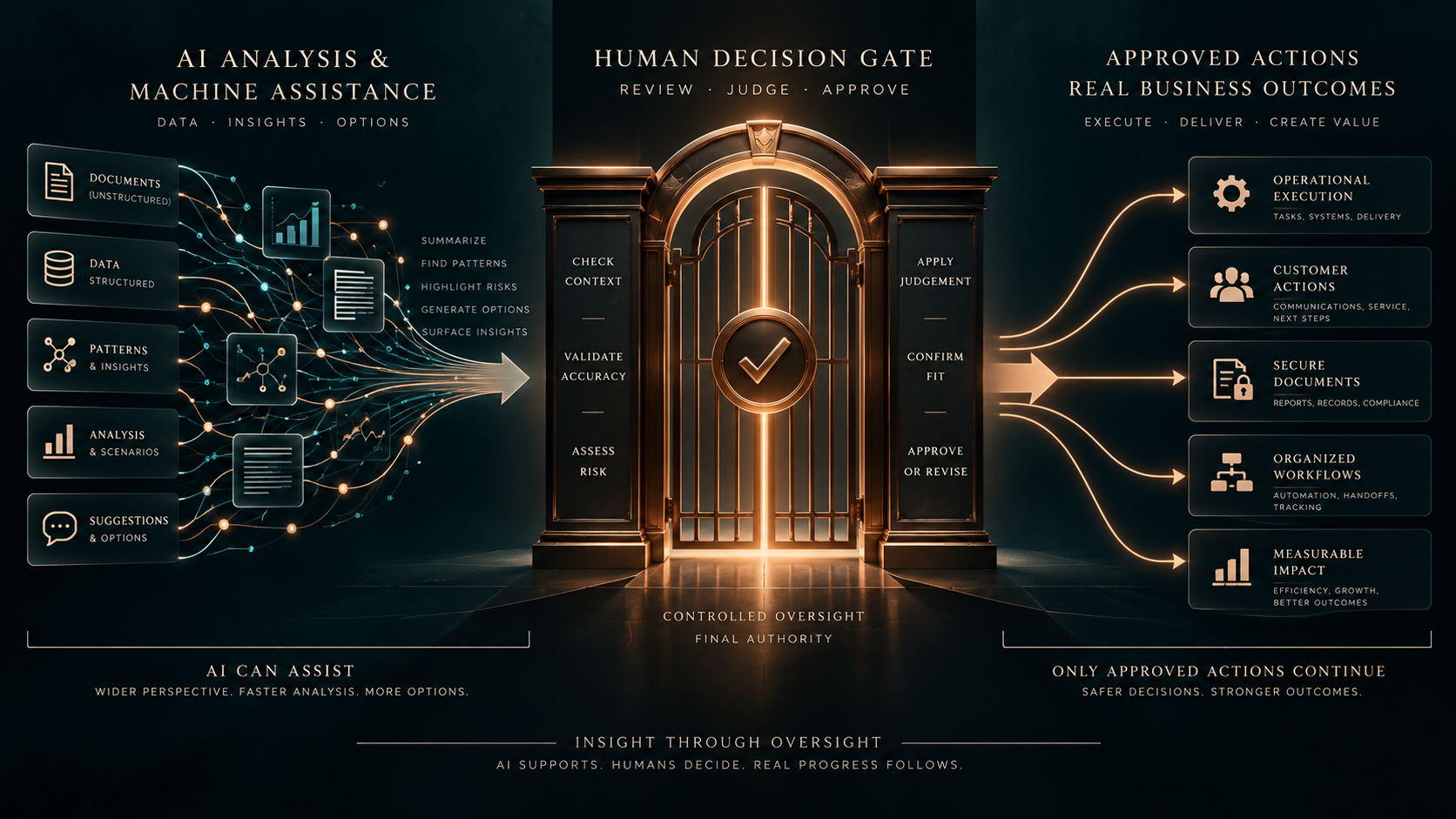
11. Good AI governance does not need enterprise bureaucracy
Small and mid-sized businesses do not necessarily need a giant governance committee to use AI responsibly. They do need some basic operating discipline. For each meaningful AI workflow, define:
Purpose
What is the AI supposed to help accomplish?
Owner
Who is responsible for the workflow?
Data boundary
What information may and may not be used?
Human checkpoint
Where is review or approval required?
Escalation
When should the AI stop and hand the work to a person?
Documentation
What should be recorded?
Review cadence
When will the workflow be reevaluated?
That is governance in practical terms.
12. The best AI workflow still has a responsible person at the end
AI may become increasingly capable. That does not change the basic operating principle. Businesses still need to know who owns the outcome.
When something matters, there should be a person who can explain the decision, challenge the system, stop the process, and accept responsibility for what happens next.
That is not anti-AI. It is what makes AI useful inside a real business.
What this means for your business
You do not need to choose between using AI and maintaining human accountability. Design the workflow so you get both. Start by identifying:
- what AI is allowed to do
- what it is not allowed to decide
- who owns the process
- what requires verification
- when escalation occurs
- what gets documented
- who approves the final action
Then keep those rules visible as the workflow evolves.
AI can make your team faster. Governance makes sure faster does not become careless.
"AI can assist with the work. It cannot inherit responsibility for the outcome."
- RACHEL CROW, FOUNDER, EMBERNOVA DIGITAL
Practical AI Integration & Governance
EmberNova Digital helps businesses identify where AI can create useful operational leverage while building the guardrails needed for human oversight, privacy, security, workflow control, and accountable implementation.
Work may include AI workflow design, tool evaluation, human-review checkpoints, governance policies, data boundaries, operational integration, and AI-enabled process improvement.