
SYSTEMS & ENGINEERING
Put AI to work inside the business, with clear boundaries around what it can do.
EmberNova Digital designs AI-enabled workflows, business assistants, knowledge tools, and connected systems around real operating needs. We identify where AI can improve the work, build it into the surrounding process, and define where human review, data boundaries, and accountability still belong.
The goal is not more AI. It is useful AI that the business can understand, control, and maintain..
2026 Best of Florida® Winner · Business Consulting Firms
Florida-based · Serving businesses nationwide · Licensed & Insured · Confidential by design
Practical AI Integration & Governance is part of EmberNova Digital’s Systems & Engineering practice.
WHEN AI MOVES FASTER THAN THE OPERATING RULES
The problem is not whether employees are using AI. It is whether the business knows how it is being used.
AI is already entering businesses through software, employee tools, customer platforms, internal workflows, and everyday experimentation.
That creates opportunity, but it also creates questions about data, accuracy, access, accountability, and which decisions still require a person.
This may be the right conversation when:
- Employees are already using AI but there are no clear expectations or policies
- Leadership wants to adopt AI without creating unnecessary privacy, security, or accuracy risk
- Teams are spending time on repetitive research, drafting, classification, or analysis
- The business is considering AI agents, assistants, or automated decision support
- Different departments are experimenting independently with different tools
- Customer or operational workflows could benefit from AI, but human review still matters
- Leadership needs a practical AI roadmap rather than another collection of disconnected tools
AI works best when the business knows what the technology is allowed to do, what it should never decide on its own, and who remains responsible for the outcome.
USEFUL BEFORE IMPRESSIVE
Start with the business problem, not the AI feature.
AI is useful when it improves an existing workflow, reduces repetitive cognitive work, helps people work with information more effectively, or creates a capability the business could not reasonably maintain manually.
Sometimes AI is the right answer. Sometimes conventional automation, custom software, better process design, or simply leaving the workflow alone is better.
The right question is not “Where can we use AI?” It is “Where does AI improve the work without weakening accountability?”
Good candidates for AI
- drafting
- summarization
- classification
- extraction
- research support
- pattern recognition
- content assistance
- knowledge retrieval
Areas that need stronger oversight
- customer commitments
- financial decisions
- legal/compliance-sensitive activity
- security actions
- employee decisions
- sensitive data
- consequential recommendations
AI WORKFLOWS & BUSINESS ASSISTANTS
Build AI into real work instead of adding another disconnected tool.
AI can support one focused task or become part of a larger operating workflow. The design should reflect the work, the information involved, the consequence of errors, and where people still need authority.
AI-Enabled Workflows
Add AI to existing processes for classification, summarization, extraction, drafting, routing, research support, analysis, and other repeatable cognitive work.
Business Assistants
Build assistants that help employees or customers find information, answer recurring questions, navigate services, prepare work, or complete defined tasks.
Internal Knowledge & Retrieval
Make approved policies, procedures, documentation, product information, and institutional knowledge easier to search and use.
Human-in-the-Loop Systems
Design workflows where AI handles useful work while people retain control over approvals, exceptions, sensitive actions, and higher-impact decisions.
AI Governance & Use Policies
Define approved tools, data boundaries, review requirements, accountability, disclosure expectations, and practical rules for responsible use.
AI Adoption & Team Enablement
Help teams understand what AI should and should not be used for, how outputs should be verified, and how to avoid unmanaged tool sprawl.
BUILT AS A BUSINESS SYSTEM
AI implementation needs more than a model and a prompt.
Production AI has to operate inside an architecture the business can understand and control.
That means defining what data the system can access, how retrieval is grounded, where human approval is required, how failures are handled, how outputs are tested, and how the system can be maintained as models and providers change.
Our AI work considers:
- system architecture and provider boundaries
- data access and privacy controls
- authentication and permissions
- retrieval grounding and source governance
- prompt-injection and misuse risk
- human approval and escalation
- testing and failure modes
- logging and monitoring
- documentation and maintainability
- ownership and portability
The difference between a demo and a business system is what happens when the happy path stops working.
Using AI already, but not sure whether the business has the right guardrails around it?
EmberNova Digital can help evaluate where AI is useful, where stronger oversight is needed, and how to build a practical approach that supports the business without giving up accountability.
FROM AI IDEA TO GOVERNED USE
Define the value, boundaries, and human role before AI becomes part of the workflow.
AI projects move quickly when the technology is clear, but they become risky when the operating rules are not.
EmberNova Digital helps businesses evaluate where AI belongs, define what information it can use, establish where human review is required, and integrate the technology into workflows that people can actually understand and manage.

1. Identify the Business Use Case
Start with the work itself.
Define the problem, the users, the information involved, the expected benefit, and what success should look like before choosing an AI tool or model.
2. Evaluate Risk & Data Boundaries
Determine what information the system may access, what should remain restricted, where privacy or security concerns exist, and which activities require stronger controls.
3. Define Human Oversight
Clarify which outputs can move forward automatically, which require review, who has authority to approve them, and what happens when the AI is uncertain or wrong.
4. Design the Workflow
Connect AI to the surrounding process, systems, data, approvals, notifications, and documentation so it functions as part of the operating environment rather than as an isolated tool.
5. Test for Real-World Use
Validate accuracy, usefulness, failure modes, edge cases, user experience, and whether the workflow performs well enough to support the intended task.
6. Govern & Improve
Document approved use, monitor performance, review changes in tools or workflows, gather feedback, and refine the system as the business learns what works.
Useful AI needs more than a prompt. It needs a clear purpose, defined boundaries, and accountable people around it.

The best AI systems make people more capable without making responsibility harder to see.
BETTER WORK WITH CLEARER OVERSIGHT
AI should increase useful capacity without making responsibility harder to see.
The value of AI is not measured by how many tasks it can touch.
The real benefit comes when it helps people work faster, surface useful information, reduce repetitive effort, improve consistency, and make better use of the knowledge already inside the business.
Used well, AI can improve capacity without creating another layer of confusion or risk.
What this can improve
- Research & information handling
- Content & communication support
- Internal knowledge access
- Workflow efficiency
- Decision support
- Capacity & scalability
PROFESSIONAL PRINCIPLES
EmberNova Digital’s approach to AI is informed by security, governance, human accountability, and practical operating requirements. Rachel Crow is a member of IEEE and the ISACA Space Coast Chapter.
AI should make people more capable without making responsibility harder to see.
RESPONSIBLE AI IN PRACTICE
Governance should make responsible AI easier to use, not harder to understand.
Once AI becomes part of everyday work, the business needs clear rules around approved tools, data, human review, accuracy, disclosure, and accountability.
Those rules should be practical enough that people can actually follow them as tools, models, and workflows change..
What that includes
- Approved tools & use cases - Define which AI tools and uses are appropriate for the business.
- Data & privacy boundaries - Set rules around confidential information, customer data, employee information, intellectual property, and other sensitive inputs.
- Human review requirements - Identify where AI outputs can move forward and where review, approval, or escalation is required.
- Accuracy & verification standards - Define how facts, calculations, recommendations, and other outputs should be checked.
- Disclosure & responsible use - Clarify when AI involvement should be disclosed to customers, employees, partners, or the public.
- Ongoing review & change management - Revisit tools, permissions, workflows, and controls as the technology and business use evolve.
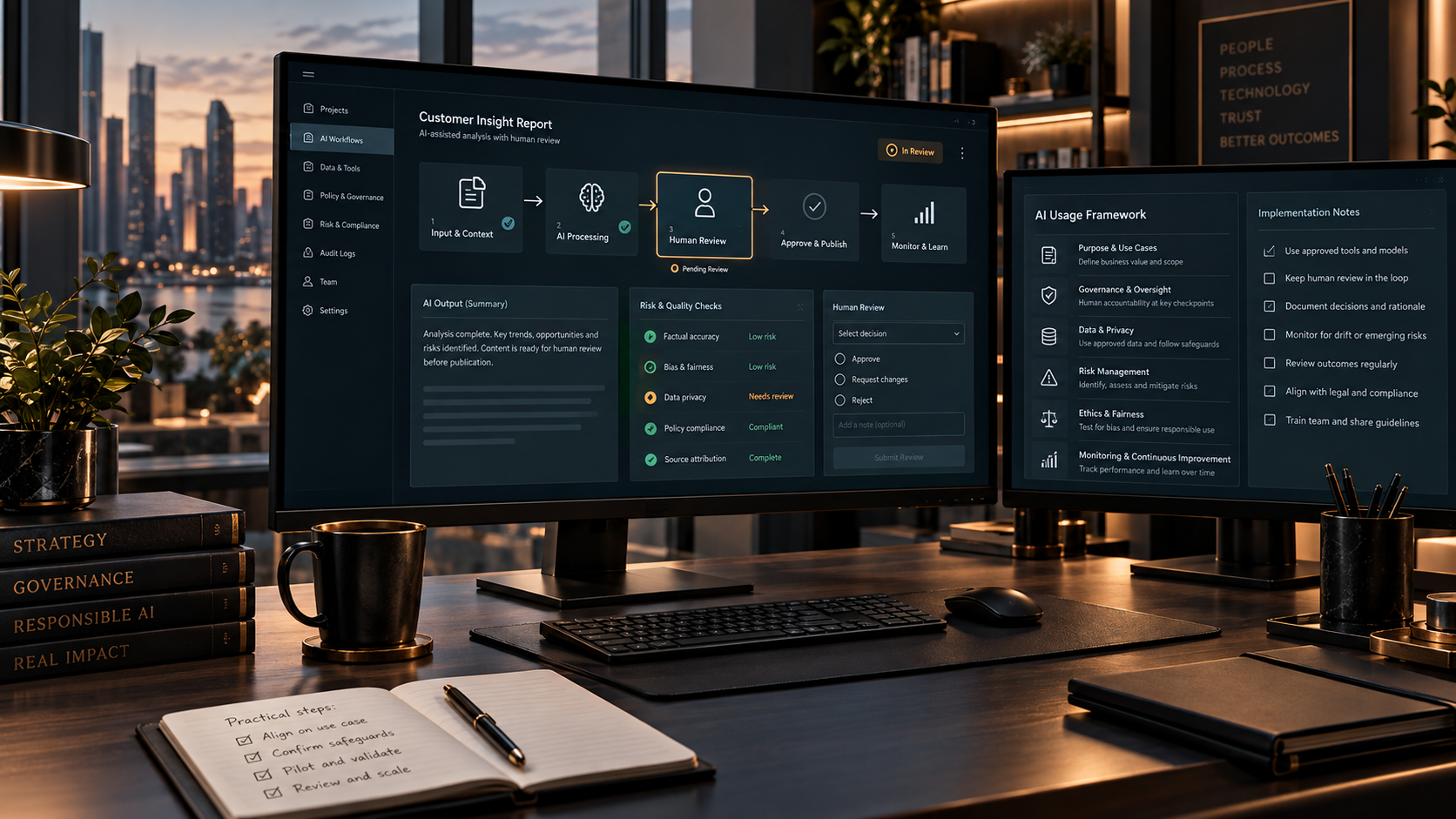
Governance works when people know where AI can help, where it needs supervision, and who remains responsible for the outcome.
USING AI IN THE BUSINESS?
AI introduces additional questions around confidential data, approved tools, vendor access, output accuracy, human review, and accountability. If AI is already part of your workflows or your team is experimenting with it, governance should be part of the risk conversation.
AI SYSTEMS IN DEVELOPMENT
What governed AI looks like when it is built into real products and workflows.
EmberNova Digital is actively building AI-enabled systems that combine useful automation with defined architecture, security boundaries, testing, human oversight, and documented operating controls. These products are at different stages of development, but each is being built around a real operating requirement rather than a standalone AI feature.
EmberNova Digital Assistant
Customer-Facing AI Assistant · Semantic Retrieval · Governed Knowledge Access
A website assistant designed to answer questions from approved EmberNova Digital knowledge, route visitors to relevant services and diagnostics, and operate within defined retrieval, security, and response boundaries.
Status: moving through correction and customer-facing product validation before staging, live LLM verification, semantic retrieval, and hosted testing.
ENDOW
Digital Workforce Platform · Governed AI · Human Approval
A digital workforce platform in architecture and pre-production development, designed to coordinate AI workers across business departments, systems, policies, approvals, and operating priorities while keeping human authorization visible for higher-impact actions.
Status: architecture and pre-production development.
ContentOps
AI-Assisted Operations · Workflow Governance · Human Review
An internal operations platform for coordinating content planning, generation, review, approvals, assets, and publishing preparation across EmberNova Digital and client accounts, with AI assisting the workflow rather than bypassing editorial controls.
Status: active internal build.
The objective is not more AI. It is better use of AI where the business can support it responsibly.
PRICING & STARTING POINTS
Start with the use case, not the model.
AI-Enabled Workflow or Business Assistant
Typically starts at $3,500–$5,000 depending on scope.
Best for a defined assistant, retrieval experience, AI-supported workflow, or focused business use case.
Typically includes: use-case definition, workflow design, model/provider integration, data and access boundaries, human-review rules, implementation, testing, and handoff.
Automation & Systems Integration
Projects typically start at $5,000.
Best when the problem is mostly workflow, routing, integration, or repetitive process rather than something that specifically requires AI.
Typically includes: workflow mapping, system design, integrations, automation build, testing, documentation, and handoff.
Custom Software, Apps & SaaS
Projects typically start at $12,500.
Best when AI is one capability inside a larger application, portal, internal system, or software product.
Typically includes: product definition, architecture, development, AI/integration components where appropriate, testing, deployment, documentation, and handoff.



COMMON QUESTIONS
AI works best when usefulness, risk, and human accountability are considered together.
Every business is at a different stage of AI adoption. Some teams are just beginning to experiment. Others are already using AI across multiple tools and workflows without clear policies, review points, or ownership. These questions cover the areas leaders most often need clarified before deciding how AI should fit into the business.
How do I know where AI is actually useful in my business?
Start with the work, not the tool. Good candidates often include drafting, summarization, classification, extraction, research support, knowledge retrieval, analysis, and other repetitive cognitive tasks where AI can assist without replacing accountability.
Do we need an AI policy if employees are only using tools occasionally?
Usually, yes. Even limited use can create questions around confidential information, customer data, intellectual property, accuracy, disclosure, and approved tools. A practical policy can be simple, but it should make the boundaries clear.
Can you help us choose which AI tools to use?
Yes. EmberNova Digital can evaluate the business need, workflow, data involved, integration requirements, cost, risk, and human-review needs before recommending whether an AI tool, conventional automation, custom software, or a different process is the better fit.
What does human-in-the-loop AI mean?
It means AI can perform useful work while a person retains authority over approvals, exceptions, sensitive actions, and higher-impact decisions. The level of review should match the risk and consequence of the task.
How much does an AI workflow or business assistant cost?
Focused AI-enabled workflow or business assistant projects typically start around $3,500–$5,000 depending on scope. Larger applications, deeper integrations, custom software, data requirements, security controls, and ongoing infrastructure can increase the investment.
Can AI be connected to our existing systems and workflows?
Often, yes. Depending on the platforms involved, AI can be integrated with documents, forms, CRM, internal knowledge, automation workflows, custom applications, reporting systems, and other business tools.
How do we protect confidential or sensitive information when using AI?
That starts with clear data boundaries, approved tools, permissions, account controls, vendor review, and rules about what information can and cannot be submitted. Sensitive uses may also require stronger technical and human safeguards.
Do you help with AI governance and ongoing oversight?
Yes. Support can include approved-tool policies, data and privacy rules, human-review requirements, verification standards, disclosure practices, permissions, monitoring, and periodic review as tools and business use change.
Can you train our team on practical and responsible AI use?
Yes. EmberNova Digital offers workshops and team sessions on practical AI adoption, responsible use, human oversight, AI literacy, and the risks of both overdependence and unnecessary fear. Consulting remains the primary path for businesses that need implementation, governance, or integration work.
USE AI WITH A CLEARER PURPOSE