

Your Marketing Got Their Attention. What Happened to the Inquiry?
Digital Infrastructure / Strategic Operations
8–10 minutes
Your Marketing Got Their Attention. What Happened to the Inquiry?
Imagine a construction company investing in a campaign for its commercial renovation services. The advertisements look good. The new project photographs attract attention. Prospective customers click through to learn more. A few people fill out the website's contact form. A few others call. The marketing team reports that traffic is up, but the company isn't seeing the conversations it expected.
It's tempting to increase the budget or redesign the landing page. Before doing either, someone needs to answer a less glamorous question: What happens to an inquiry once it enters the business? A website can make a convincing first impression while the process behind it makes a response surprisingly difficult. Understanding that process is often where the useful work begins.
KEY TAKEAWAYS

- A marketing campaign can generate genuine interest while the company struggles to receive, qualify, or follow up on inquiries.
- A working contact form does not establish that a lead reaches an accountable person or enters the right operating system.
- Website messaging and the services a company currently sells should agree with what advertisements, search listings, and referrals promise.
- The practical starting point is to trace one inquiry from first contact through a real business response.
- The solution may be a content refresh, better configuration, an integration, a process change, or a combination.

The customer thinks contacting your business is one step
Consider the prospective customer who finds a builder through a referral. They visit the site, check the portfolio, and complete an estimate-request form.
In the customer's mind, they've contacted the company. Internally, that submission may need to pass through marketing, office administration, estimating, and a project manager before a useful response can be made.
There is nothing inherently inefficient about that sequence. A commercial project may genuinely require multiple departments. The problem arises when responsibility between the steps is unclear.
Who saw the inquiry? Was it entered in the CRM? Did the estimator receive the drawings? Was the prospective customer told what happens next? Can anyone see whether a response was sent?
A business can have good people and good technology without having a fully connected inquiry process.
1. First, determine whether the business is attracting the right interest
Before blaming follow-up, establish what people were promised when they arrived.
Imagine a company whose advertisement promotes design-build commercial renovations, while the website still emphasizes smaller residential work completed several years earlier. The visitor may have reached the intended business but still feel uncertain about its current capabilities.
The same mismatch can happen between the website, Google Business Profile, social media, and project galleries. A company may have moved into a new market or expanded its services without updating each place customers encounter it. Look at the arrival path from a prospective customer's perspective:
- Does the advertisement or search result lead to a relevant page?
- Are the current services explained in ordinary customer language?
- Do examples show the kind of work the business wants today?
- Is the next action clear for someone who is ready to inquire?
- Can the visitor find an alternative contact method if a form is inconvenient?
There may be no technical failure at all. The website could simply be telling an older version of the company's story.
2. Test the contact route as an actual customer would use it
A form displaying a success message is only the beginning of the test. Use an authorized test inquiry on the desktop and mobile versions of the website. Where appropriate, test each major service form or quotation pathway. Confirm that the inquiry is visible to the people who should receive it.
Record what happened: the submission time, the destination, whether the information was complete, which notification fired, and whether the next employee could act without asking the customer to repeat information. Test calls, scheduling links, and other contact methods separately. A business may be doing well with one pathway and missing opportunities through another.
Avoid sending real customer data through a test system. Use controlled test details and tell the relevant staff so they can distinguish the exercise from a legitimate prospect.
3. An inbox is not necessarily a lead-management process
An inquiry arrives in an office email address. One employee forwards it to a manager. The manager requests a few details, and someone else prepares the estimate. That approach may be perfectly adequate at low volume, particularly when the team has clear ownership. But as activity grows, it becomes harder to answer straightforward management questions:
- How many requests came in this week?
- Which service categories are attracting interest?
- Which inquiries are waiting on an internal response?
- Which were qualified, quoted, won, or declined?
Those questions require consistent statuses and responsibility. They don't always require a new CRM. A shared mailbox configured correctly, an existing CRM workflow, or a documented assignment rule may be enough. In another business, an integration between its forms and project management system may be the missing piece.
The goal is to keep a valid inquiry visible and accountable as it moves through the company.
4. Follow the handoff from inquiry to estimate
For a service business, the inquiry itself is rarely the finished transaction. The next step might involve product or project qualification, document collection, a site visit, scheduling, pricing, and approval. Several departments may participate. A handoff becomes much easier when the information collected in the first step is designed around the needs of the next one.
For example, a construction estimator may need a project location, type of work, approximate timeline, drawings, and preferred contact method. A customer-service representative may only need enough to route the inquiry correctly before a specialist collects the technical details.
Collecting every possible field up front can discourage customers from completing a form. Collecting too little can force several rounds of follow-up. The right balance depends on the service and the business's intake process.
Follow an inquiry through the full workflow. Note any place where someone copies information into another system, recreates a document, or depends on an informal conversation to know what happens next.
5. Look for the difference between visibility and accountability
A dashboard might show that an inquiry exists, but that doesn't establish that someone owns the response. Useful tracking should answer who is responsible for the next action, what the current status means, when the next action is due, and how exceptions are handled.
There is also an important difference between marketing attribution and operating accountability. A campaign may deserve credit for attracting interest. The sales or estimating process needs to account for what happened to that interest after it arrived.
Businesses should avoid drawing strong conclusions from incomplete data. A low number of sales may reflect poor-fit traffic, a long buying cycle, capacity limitations, weak intake, or a genuine drop-off in follow-up.
Investigation comes before diagnosis.
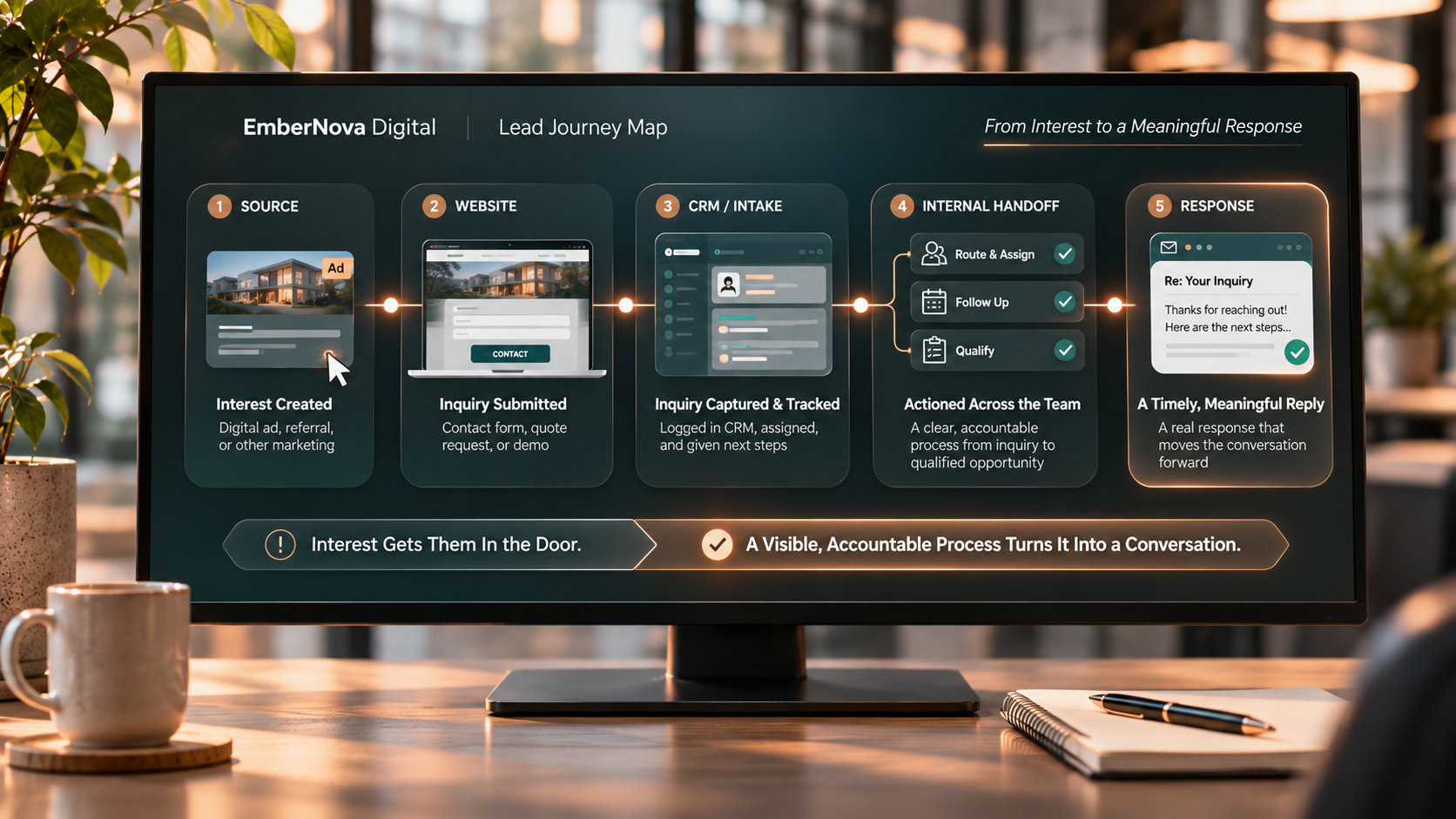
6. Measure outcomes that reflect the actual customer journey
Traffic and form submissions remain useful. They just don't tell the whole story. Depending on the company, useful measures might include:
- Valid inquiries received by service or source.
- Time until first meaningful response.
- Inquiries awaiting assignment or qualification.
- Estimates requested versus estimates completed.
- Qualified opportunities that progress to a sales conversation.
- Follow-up tasks completed or overdue.
- Won work, when attributable and measured appropriately.
Define each measure consistently. A spam submission and a genuine commercial project inquiry should not necessarily count as equivalent leads. A contact form completion should not be called a sale.
For businesses with long sales cycles, the most useful early evidence may be consistent response and opportunity progression rather than immediate revenue.
A business may need help with a stronger website, cohesive messaging throughout digital assets, analytic and system integration, and the systems that support them.
EmberNova Digital works with business owners on the operational infrastructure behind growth, including planning, systems, documentation, digital infrastructure, and strategic execution.
7. Decide what to improve before buying more technology
Once the handoff is understood, several reasonable solutions may emerge:
Update content. The website may need clearer descriptions of current services, more relevant project examples, or better contact pathways.
Configure existing software. A CRM may already offer routing, notifications, stages, or task ownership that were never fully set up.
Connect the systems. A form may need to create a record in the CRM, notify a responsible person, or attach an inquiry to the correct account.
Change the process. The company may simply need a named intake owner and a clear response procedure.
Build a focused tool. When requirements are distinctive, a custom quoting or intake workflow may be appropriate.
The solution should be proportionate to the actual problem. Rebuilding a website or replacing the CRM without following the inquiry journey can create another project without resolving the underlying handoff.
EmberNova Digital assists with this via
Website Development & Digital Infrastructure
and
Automation & Business Systems.
8. One practical exercise: trace five controlled inquiry scenarios
Ask the people who handle customer inquiries to help run a brief process test. Use realistic but clearly marked sample requests covering the main contact paths: a straightforward service request, a higher-value project, an incomplete inquiry, a service that needs specialist review, and a request arriving outside normal business hours.
Track each from the first action through the point at which the right person can respond. Document the destination and status of each request, any manual handling, and any failed notifications. Then ask the team which steps caused uncertainty and which were easy.
This is a much more informative exercise than simply deciding the business needs a different contact form.
9. Don't overlook the infrastructure behind the first click
A customer's inquiry may also depend on domain and DNS configuration, website hosting, email delivery, spam filtering, third-party integrations, administrative permissions, and the tools used to receive notifications. A broken forwarding rule or expired integration can affect the customer experience without changing the appearance of the website.
The company should know who manages those dependencies and how to test or recover them. Some responsibilities belong to managed platform providers; others belong to the business or its service partners.
A useful review considers the visible website and the underlying systems together.

What this means for your business
Before increasing a marketing budget, follow the route a real prospect takes from finding the business to receiving a meaningful response.
If the inquiry reaches the right employee and the company follows up effectively, focus on improving the earlier part of the customer journey. If inquiries are arriving but difficult to track or assign, examine the internal handoffs. If visitors don't recognize the services or capabilities advertised, review the site's content and presentation.
The strongest conclusion comes from understanding where the process is actually losing momentum.
“Before spending more to bring people to the website, I want to know what happens to the people already arriving.”
- RACHEL CROW, FOUNDER, EMBERNOVA DIGITAL
Website Development, Infrastructure & Business Systems
EmberNova Digital helps established companies understand and improve the customer journey through their websites, lead capture, digital infrastructure, integrations, and internal workflows.
The work may involve updating a website, clarifying current services, improving contact pathways, connecting existing applications, or developing a specialized internal workflow.
If you're investing in marketing and would like to examine what happens between the first click and the first customer conversation,
discuss your project with EmberNova Digital.